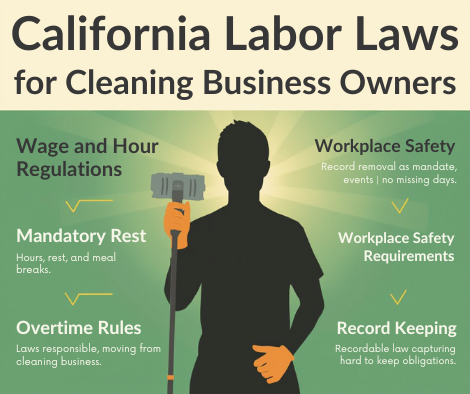
If you run a cleaning business in California, you aren’t just a business owner; you are a tightrope walker.
From San Diego to Sacramento, California is widely known as the most difficult state in the nation to be an employer. The labor laws here are stricter, the penalties are higher, and the lawsuits are more frequent than anywhere else in the US.
For a cleaning company—where your workforce is mobile, hourly, and often fluctuating—the risk is massive. A single missed lunch break violation or a misclassified employee can cost you tens of thousands of dollars in PAGA (Private Attorneys General Act) penalties.
But here is the good news: Compliance is manageable if you have the right tools.
In this guide, we are going to break down the specific “California-only” headaches that cleaning business owners face and how modern management software acts as your digital shield.
1. The “AB5” Nightmare: Employee vs. Independent Contractor
In many states like Texas or Florida, it is relatively easy to hire cleaners as “1099 Independent Contractors.” This saves the owner money on taxes and insurance.
In California, Assembly Bill 5 (AB5) changed everything. It introduced the “ABC Test,” which makes it incredibly difficult to legally classify a cleaner as a contractor if cleaning is your primary business.
The Reality: If you are running a cleaning service in CA, you almost certainly need to hire W-2 employees. The Software Fix: Managing W-2 employees requires strict record keeping. You need to track sick leave accrual (California requires a minimum amount of paid sick leave), payroll taxes, and workers’ comp. [Cleaning Business Management Software] integrates with payroll providers like Gusto or ADP, ensuring that when you hire that W-2 cleaner in Los Angeles, their tax withholdings are calculated automatically based on their GPS-verified hours.
2. The “Meal Break” Trap
This is the #1 reason California service businesses get sued.
The Law: In California, if an hourly employee works more than 5 hours, they must take an unpaid, uninterrupted 30-minute meal break.
- It cannot be a “working lunch.”
- They must be relieved of all duties.
- If they work 5 hours and 1 minute without a break, you owe them an extra hour of pay as a penalty.
The Logistics Problem: Your cleaner is alone in a house in San Jose. You are in your office. How do you know if they took their lunch break? If they say they did, but months later claim they didn’t, and you have no proof, you lose.
The Software Fix: A robust [Clock-in Clock-out App] is your defense.
- Break Enforcing: The app can prompt the cleaner: “You have worked 4.5 hours. You must take a break in 30 minutes.”
- Digital Attestation: When they clock out for the day, the app asks: “Did you take your compliant meal breaks today?” The employee must tap “YES” to submit their time. This digital signature is your evidence in court.
3. Daily Overtime (The 8-Hour Rule)
Federal law only requires overtime pay after 40 hours in a week. California requires overtime pay after 8 hours in a single day, even if the employee only works 20 hours that week.
The Scenario: You have a massive deep clean in Orange County. You ask a crew member to stay late to finish it. They work 12 hours on Tuesday but take Friday off.
- Without Software: You might pay them straight time for the 12 hours because they didn’t hit 40 for the week. You just broke the law.
- With Software: The system automatically flags the hours over 8 as “1.5x Overtime” and the hours over 12 as “Double Time” (another CA rule). It calculates the blended rate automatically, so your payroll is bulletproof.
4. Split Shift Premiums
Did you know that if you schedule a cleaner for a shift in the morning (8 AM – 12 PM) and then bring them back for an evening office clean (5 PM – 9 PM) on the same day, you might owe them an extra hour of pay?
This is called a “Split Shift Premium” in California. It is designed to compensate workers for having their day broken up.
Managing this on a spreadsheet is a math nightmare. Good management software detects split shifts automatically. It checks the gap between the two shifts and applies the premium if the employee’s pay rate triggers the requirement.
5. PAGA: The “Private Attorneys General Act”
PAGA allows an employee to sue you not just for their own lost wages, but on behalf of all your employees for labor code violations. This turns a $50 dispute into a $500,000 class-action lawsuit.
The only defense against PAGA is perfect documentation.
- You need the exact GPS location of where they clocked in.
- You need the timestamp of every break.
- You need a record of every schedule change.
If you are using paper timesheets, you cannot win a PAGA case. Paper gets lost. Paper can be forged. Digital records stored in the cloud are your safety net.
Conclusion: Don’t Leave Your Business Exposed
Running a business in the Golden State offers massive opportunities. There is immense wealth in areas like Beverly Hills, Marin County, and Silicon Valley. People here pay a premium for high-quality service.
But that opportunity comes with responsibility. You cannot run a “wild west” operation here.
Investing in Cleaning Business Management Software isn’t just about scheduling efficiency; it is your legal insurance policy. It handles the math, the breaks, and the records so you can focus on the cleaning.
Protect your California business today. Start your 7-Day Free Trial and see how easy compliance can be.