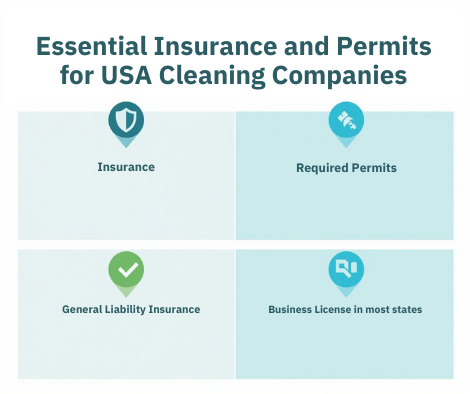
The foundation of any legitimate cleaning company in the United States, whether a small maid service or a large commercial janitorial firm, rests on proper insurance coverage and legal licensing. Consequently, securing the correct permits and insurance is not just a best practice; it is often a legal and contractual requirement that protects your business from the significant financial risks associated with property damage, bodily injury, and employee dishonesty.
This comprehensive guide details the essential policies and required permits, ensuring you are compliant across the national and local landscape.
I. Essential Insurance Policies for All Cleaning Businesses
Every cleaning business in the USA must maintain a core insurance bundle. These policies safeguard your assets and cover the most common risks encountered on client property.
1. General Liability Insurance (GLI)
General Liability Insurance (GLI) is the single most essential policy and is often required by clients before agreeing to hire your business.
- What it Covers: This policy protects your business from claims that it caused bodily injury (e.g., a client slips on a wet floor you just mopped and breaks a wrist) or property damage to a third party (e.g., an employee breaks a client’s window while cleaning). It also typically covers legal defense costs.
- Average Cost (USA): GLI averages about $48 per month, or $580 per year, for most cleaning companies. However, this can vary by state, with New York and California often seeing higher rates (e.g., $155 and $148 monthly, respectively).
- Policy Limits: Most cleaning business owners choose a general liability policy with a $1 million per-occurrence limit and a $2 million aggregate limit.
2. Workers’ Compensation (Workers’ Comp)
This is a mandatory policy for cleaning businesses with employees in nearly every state across the USA.
- Legal Requirement: Businesses in every state, excluding Texas, are legally required to carry Workers’ Compensation if they have employees. The coverage may also need to be extended to your contractors.
- What it Covers: The policy helps offset medical expenses for your employees if they become sick or injured while working (e.g., a cleaner slipping on a wet floor or having an asthmatic attack due to chemicals). It can also help cover lost wages while an employee is undergoing treatment.
- Average Cost (USA): Workers’ Compensation averages about $136 per month or $1,627 per year. Costs depend on the number of employees and their occupational risk level.
3. Professional Liability Insurance (E&O)
Also known as Errors and Omissions (E&O) insurance, this covers claims related to mistakes or negligence in the service you perform.
- What it Covers: This policy protects against lawsuits claiming your service caused injuries or financial losses due to negligence or non-performance. An example would be if your crew mistakenly used the wrong chemical on a floor, causing permanent discoloration, or failed to perform a requested service, leading to subsequent damage.
- Average Cost (USA): Professional Liability averages around $55 per month or $656 per year.
4. Commercial Auto Policy
This is required if your cleaning business owns or uses vehicles for work purposes.
- Legal Requirement: Business vehicles owned by a house cleaner must have this coverage to comply with state laws.
- What it Covers: Protects vehicles, drivers, and pedestrians involved in an accident. It covers medical expenses and the costs involved in repairing or replacing the vehicle. Standard personal auto insurance will not cover accidents that occur while the vehicle is being used for business purposes.
- Average Cost (USA): Commercial Auto Insurance averages about $173 per month or $2,075 per year.
II. Bundling and Advanced Coverage Options
To simplify management and reduce premiums, cleaning companies often bundle their required policies.
1. Business Owner’s Policy (BOP)
A BOP is an affordable package combining multiple essential policies into one convenient plan, working best for most small businesses.
- What it Includes: Typically combines General Liability Insurance and Commercial Property Insurance. Some BOPs may also include Business Income Insurance to replace lost revenue if you cannot operate temporarily due to covered property damage.
- Average Cost (USA): A BOP averages about $76 per month or $907 annually. The Hartford’s cleaning business customers paid about $1,553 annually, or $129 per month, for a BOP.
2. Commercial Property Coverage / Tools and Equipment
This insurance protects your physical assets, which are significant for commercial and residential firms.
- What it Covers: Protects owned or rented buildings, equipment, supplies, and inventory (e.g., extension poles, vacuums, mops) in case of damage, loss, or theft (such as fire).
- Coverage Details: This is sometimes called Inland Marine Insurance when covering tools and equipment transported in business vehicles.
- Average Cost (USA): Tools and Equipment Insurance can start at around $51.64 per year for lower limits.
3. Commercial Umbrella Insurance
- What it Covers: Umbrella insurance provides extra protection by increasing the coverage limits of underlying liability policies (GLI, Commercial Auto, Employer’s Liability). This is vital for very large claims or lawsuits that exceed your standard policy limits.
- Average Cost (USA): This policy averages about $67 per month or $801 annually.
III. Bonds: Fidelity vs. Surety (Theft Coverage)
Bonds are often misunderstood but are crucial for securing client trust, particularly for commercial or high-end residential cleaning.
1. Fidelity Bonds (Employee Dishonesty Coverage)
A fidelity bond is essentially an insurance policy that protects the employer from internal threats.
- What it Covers: This bond protects your business from financial loss due to dishonest acts by your employees, such as theft, fraud, or embezzlement of funds.
- Client Protection: If an employee steals from a client, your fidelity bond can reimburse you for reimbursing your client. This is sometimes called a “Business Service Bond” when the coverage protects the client from employee theft while services are being carried out.
- Average Cost (USA): Janitorial bonds (a type of fidelity bond) are highly affordable, averaging about $11 per month or $126 annually.
2. Surety Bonds
A surety bond is a three-party agreement that guarantees the fulfillment of a contract or compliance with regulations.
- What it Covers: It protects third parties (your clients or government entities) from your business failing to deliver on contractual obligations (e.g., you abandon a project) or meet licensing requirements.
- How it Works: The surety pays the damaged party if you fail, but you (the principal) are then required to reimburse the surety for every penny paid out. It is like a line of credit, not a traditional insurance policy.
- Requirement: Some commercial and government clients may require a surety bond to be in place before you are allowed to bid on or start work.
IV. Required Permits and Licenses (National & Local)
While there is no single “cleaning license” in the USA, compliance involves several layers of permits based on your location and service type.
1. Federal/National Requirements (EIN)
- Employer Identification Number (EIN): Required for all US businesses that hire employees or operate as an LLC, corporation, or partnership. This number, issued by the IRS, is necessary for tax filing and payroll processes.
2. State-Level Licensing and Registration
- General Business License/Registration: Nearly every state requires some form of registration or a general business license to operate legally and pay taxes. This is sometimes obtained through the Secretary of State or Department of Revenue.
- Examples: Alabama requires a state business privilege license. Alaska mandates a state business license for all businesses. Florida requires cleaning services to register with the Department of State. Nevada requires a state business license through the Nevada Secretary of State.
- Sales Tax Permit: If you plan to sell tangible cleaning products (like specialized solutions or soaps) or add product costs to invoices, you will need a sales tax permit (or seller’s permit) from your state’s Department of Revenue.
- DBA Registration: If your business operates under a name different from your legal name (like a sole proprietor using a catchy brand name), you must register a “Doing Business As” (DBA) with your local county clerk’s office.
3. Local/Specialized Licenses
- City/County Business License: Even if your state does not require a state-level license for general services, a local municipality business license is almost always required to operate within a specific city or county. For example, in Los Angeles, you apply through the Office of Finance.
- Niche Licenses: Certain specialized services require specific licenses to ensure compliance with health and environmental regulations.
- Hazardous Waste Handling: Required if you dispose of biohazards, medical waste, or other regulated materials.
- Pesticide Applicator: Needed if you use pest control chemicals as part of your service.
- Pressure Washing: Required in some specific areas for high-pressure exterior cleaning.
- California Janitorial Registration: Janitorial businesses in California must register with the Labor Commissioner’s Office.
📈 Next Step: Secure Your Compliance
Ensuring you have the correct legal and financial protections is the first step to scaling your cleaning business.
You can experience the competitive edge of ProCleanerUS compliance-focused platform immediately when you start your 7-Day Free Trial.